
What does buying new construction in Temecula actually involve?
If you want the bigger picture on the city first, the schools, the traffic and the neighborhoods, start with our Temecula city guide. This post is about one thing: how you buy a brand-new home from a builder in Temecula, California, without getting surprised at the closing table.
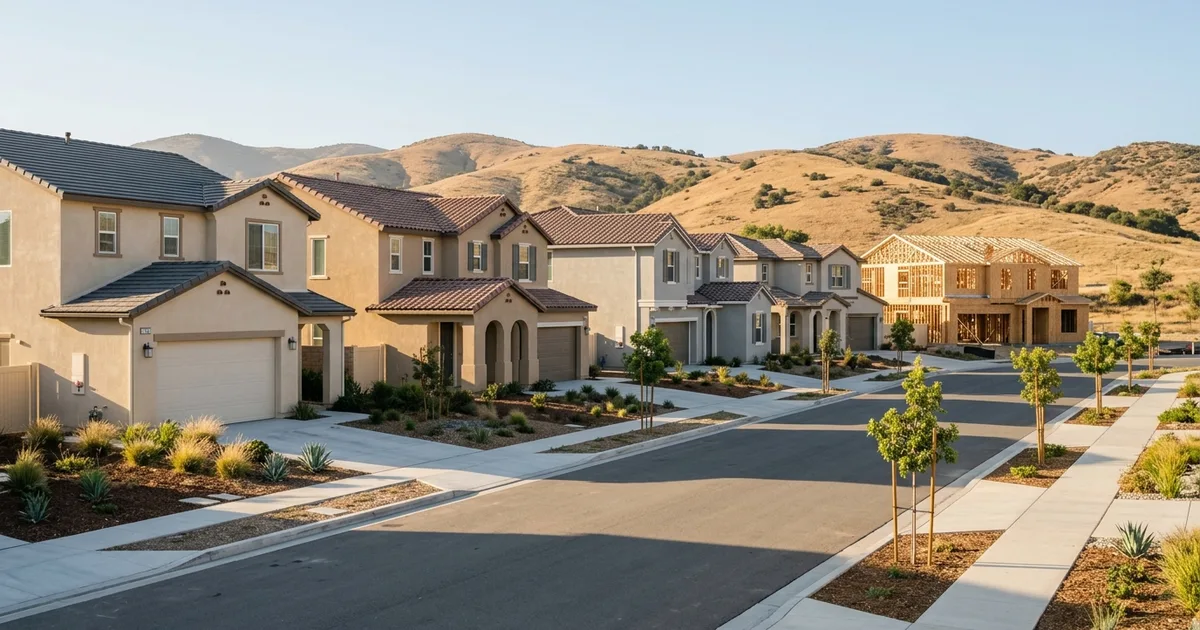
Now, buying from a builder is not the same as buying a resale. On a resale you negotiate with an owner who lived in the house. On new construction you sign the builder's own purchase agreement, written by the builder's attorneys, and you deal with a sales office that works for the builder. The house may be finished, half built, or still a slab. And on most new tracts in Southern California there is a Mello-Roos special tax and an HOA on top of your regular property tax.
New homes are still being approved here. In March 2026 the Temecula Planning Commission took up Elderberry Park, a Taylor Morrison project of 164 single-family homes from 1,993 to 3,252 square feet on the field bounded by Temecula Parkway, Butterfield Stage Road and De Portola Road, and grading had already started (Patch, March 3, 2026). The city's own Mello-Roos list also names Altair and Prado among its newest districts (City of Temecula, October 2026).
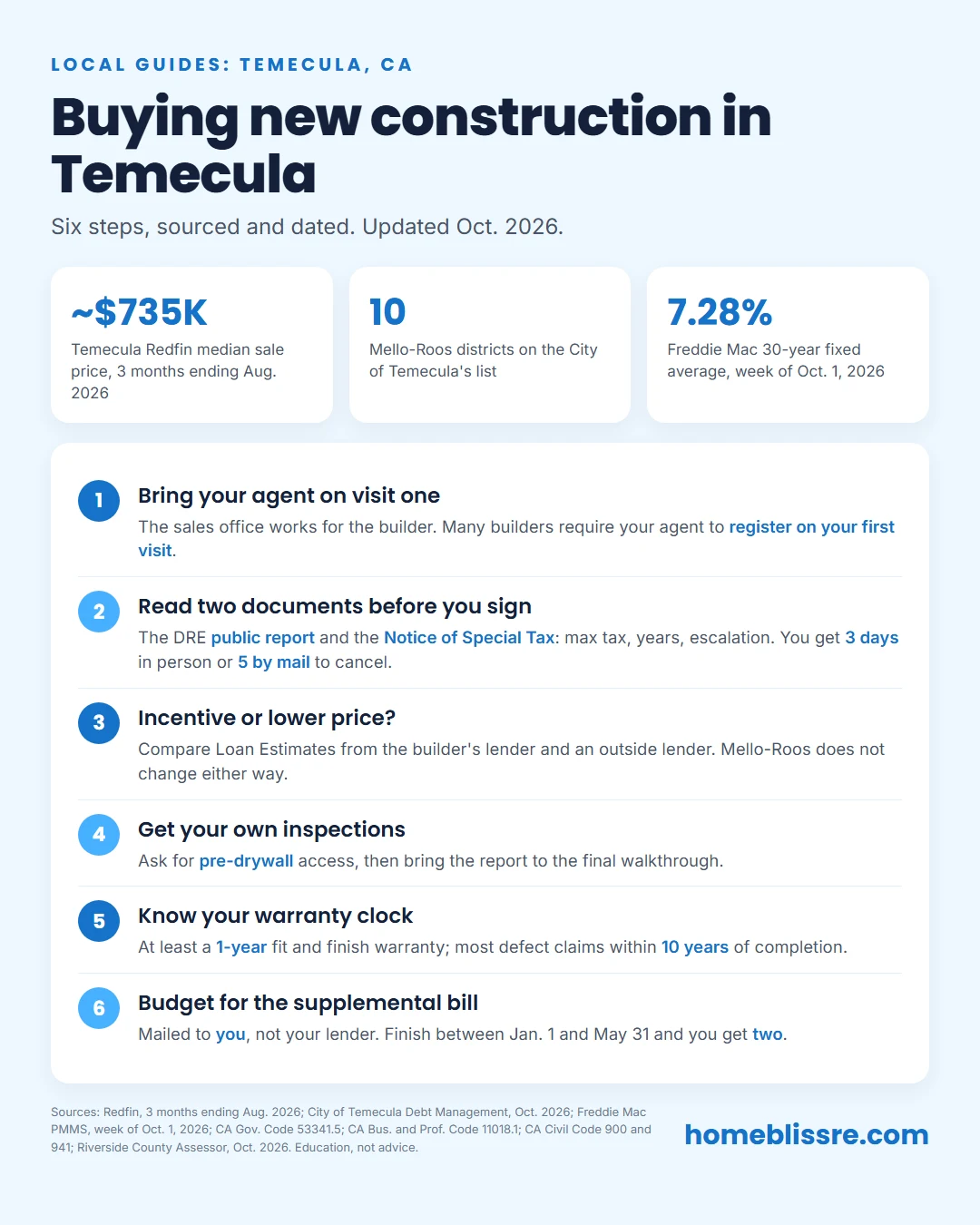
So again, here is the order we walk buyers through:
- Bring your agent to the very first builder visit.
- Read the public report and the Notice of Special Tax before you sign anything.
- Compare the incentive against a lower price, with real loan numbers.
- Get your own inspections, then a written final walkthrough list.
- Know your warranty dates and the supplemental tax bill that comes after closing.
This guide is about the buying process. To see what is actually selling nearby, our guides to new homes in Murrieta and new homes in Menifee by price tier list communities and builder prices, with the date we checked.
Do you need your own agent when you buy from a builder?
You do not have to have one, but I will be brutally honest with you: the friendly person in the model home works for the builder. Their job is to sell that builder's homes at that builder's price, on that builder's contract. Your own agent works for you, and the builder usually already prices in agent compensation through its broker cooperation policy. That policy varies by builder, so ask for it in writing.
Here is the catch most people miss. Many builders will only work with your agent if the agent is with you, or registered for you, on your first visit or first online sign-up. Walk in alone, fill out the guest card, and you may lose the option to bring representation later in that community. Check the builder's registration rule before you set foot in the sales office.
What does your own agent do on a new build?
- Reads the builder's purchase agreement with you, including deposits, the estimated completion date, and what happens if the home is late.
- Compares the incentive against a price cut with real numbers from more than one lender.
- Pulls resale comps nearby, so you know what a similar home sells for on the open market.
- Lines up your independent inspector and keeps the walkthrough list honest.
We put our own agreement with you in writing before we tour, so you know exactly how we get paid and by whom.
How do you look up Mello-Roos on a new Temecula home?
On a resale you can pull the seller's tax bill and read the special tax lines. On a brand-new home there may not be a full bill on that parcel yet, so the documents the builder hands you matter more. If the 1%, voter bonds and Mello-Roos are new to you, read our Riverside County property tax guide first.
The Notice of Special Tax
California law requires the subdivider to give you a Notice of Special Tax, and have you sign it, before you sign a purchase contract or deposit receipt. The notice has to show the maximum special tax, the years it can be levied, any escalation rate, and the facilities and services it pays for (Government Code section 53341.5). Read three lines first: this year's tax, the maximum tax, and how much it can climb each year.
The city, school and county layers
The City of Temecula lists 10 Community Facilities Districts on its Debt Management page: Harveston, Harveston II, Wolf Creek, Crowne Hill, Roripaugh Ranch, Roripaugh Ranch Phase 2, Municipal Services (CFD 19-01), Heirloom Farms, Altair and Prado. School districts can form their own CFDs too, and Temecula Valley Unified has a CFD lookup by parcel number. One parcel can sit in more than one district.
| Line on a new Temecula home's tax bill | How it is set | Where to check, as of |
|---|---|---|
| 1% general levy plus voter-approved bonds | Percentage of assessed value, set when the home is completed or sold | Riverside County Assessor and Auditor-Controller |
| City Mello-Roos (CFD) special tax | Flat formula by the district, often by home size | Notice of Special Tax; City of Temecula, October 2026 |
| School district CFD, if any | Flat formula by the school district | TVUSD CFD lookup by parcel |
| Measure C parks and lighting tax | $74.44 a year per home (every Temecula owner pays it) | City of Temecula, October 2026 |
| Service Level B street lights | $25.68 a year per single-family home or condo | City of Temecula, October 2026 |
| HOA dues | Set by the association budget | HOA documents and the public report |
Want to see what an older Temecula district looks like on paper? Our Harveston guide walks through CFD 01-2's published maximum rates. Every district has its own formula, so never borrow one community's number for another.
Is a builder incentive better than a lower price?
Builders often prefer to give you an incentive over cutting the price, because a lower price shows up in the public sale records and becomes a comp for every home left in the tract. Incentives often come as closing cost credits, a rate buydown, or upgrade credits, and many are tied to using the builder's preferred lender. That can be a good deal. It can also be a wash. So run the numbers.
Here is a hypothetical on a $735,000 home, about Temecula's Redfin median sale price for the 3 months ending August 2026, with 10% down at Freddie Mac's 7.28% average for the week of October 1, 2026. This is principal and interest only, not a quote from any lender.
| Option (hypothetical) | 10% down payment | Principal and interest per month | Also changes |
|---|---|---|---|
| Full price, no incentive, 7.28% | $73,500 | About $4,526 | Baseline |
| $20,000 price cut, 7.28% | $71,500 | About $4,403 (about $123 less) | Loan is $18,000 smaller; 1% general levy about $200 a year lower |
| Credit that buys the rate down half a point, to 6.78% | $73,500 | About $4,304 (about $222 less) | Only as long as you keep that loan; a temporary buydown steps back up |
What a credit really buys depends on the lender's pricing that day, so ask for a Loan Estimate from the builder's lender with the incentive and one from an outside lender without it, and compare them side by side. A permanent rate buydown helps most if you plan to keep the loan for years. A price cut helps if you expect to refinance or sell sooner, and it lowers the assessed value your property tax is based on. Mello-Roos does not change either way, since it is not a percentage of the price.
Also read who pays what in escrow. Riverside County's documentary transfer tax is $1.10 per $1,000 of value (Riverside County Assessor-County Clerk-Recorder), and on new construction the builder's contract spells out who pays it, along with escrow and title. Do not assume it works like a resale.
Should you get a home inspection on a brand-new home?
Yes. The city inspects a new home for code, which is the minimum, not a quality check on every finish. Your own inspector works for you. Ask the builder in writing whether you can bring an inspector at two points:
- Pre-drywall. Before the walls close up, an inspector can look at framing, plumbing, electrical runs, insulation and windows. Some builders allow it with notice, some do not. Find out before you sign.
- Before the final walkthrough. Bring the inspector's report to your builder walkthrough and get every item on the builder's written list.
After closing, the clock matters. California requires builders to give a written fit-and-finish warranty of at least one year for things like cabinets, mirrors, flooring, walls, countertops, paint and trim (Civil Code section 900). Most defect claims under the same law must be brought within 10 years of substantial completion (Civil Code section 941). Builders often add their own warranty on top, with its own claim process, so read it and put a reminder in your phone a couple of months before the one-year mark to walk the house again.
How long does it take to buy a new build, and what can go wrong on timing?
It depends on which kind of home you buy. A quick move-in home is one the builder already started or finished, so the timeline looks more like a resale. A to-be-built home is sold before or during construction, and you wait while it is built. Here is how the stages line up and what to ask at each one.
| Stage | What happens | What to ask or get in writing |
|---|---|---|
| Registration and first visit | You tour the models with your agent | The builder's agent registration rule and broker policy |
| Before you sign | Builder gives the DRE public report and the Notice of Special Tax | Signed receipts, the maximum special tax, HOA budget |
| Contract and deposit | You sign the builder's purchase agreement | How much of the deposit is refundable, and when it goes hard |
| Loan and design choices | You lock in options and start the loan | Design selection deadlines and how a rate lock covers a late finish |
| Construction | The home is built and inspected by the city | Pre-drywall inspection access and progress updates |
| Walkthrough and closing | Final walkthrough, then escrow closes | A written list of fixes and dates |
| After closing | Supplemental tax bill, warranty period | Cash set aside for the supplemental bill; your warranty dates |
Two timing traps. First, the completion date in a builder contract is usually an estimate, so do not give notice on your rental or tell your employer a firm move date until the builder confirms. Second, the supplemental tax bill. The Riverside County Assessor reappraises a home when new construction is completed, and the supplemental bill is mailed directly to you, not to your mortgage company. If construction is completed between January 1 and May 31, you get two separate supplemental bills (Riverside County Assessor-County Clerk-Recorder, October 2026). Budget for it in cash.
What should you check on the lot and the community before you sign?
The model home sells the house. The lot and the paperwork decide how you live in it.
- The lot. Ask about lot premiums, backyard size and slope, what sits behind the back fence, and whether front and back landscaping are included or extra.
- The public report. It covers things like the HOA, assessments and the subdivision itself. Read it, do not just sign the receipt.
- The HOA. Get the budget and the dues, and ask whether dues are expected to change when the builder finishes selling.
- What is coming next door. New communities sit next to open land. Check the City of Temecula's planning pages for approved projects nearby, like the Elderberry Park approval covered above.
- Schools. Confirm the assigned schools for the exact address with Temecula Valley Unified. A sales flyer is not a boundary map.