
How is property tax calculated in Riverside County?
Paying a bill? Go to the Riverside County Treasurer-Tax Collector at countytreasurer.org. That is the official place to look up and pay a Riverside County property tax bill. This guide is for buyers who want to know what the bill will be before they buy.
Now, if you are shopping for a home in Menifee or Temecula, property tax is one of the biggest numbers in your monthly payment, and it is the one people guess at the most. So let's break it down the same way the county does.
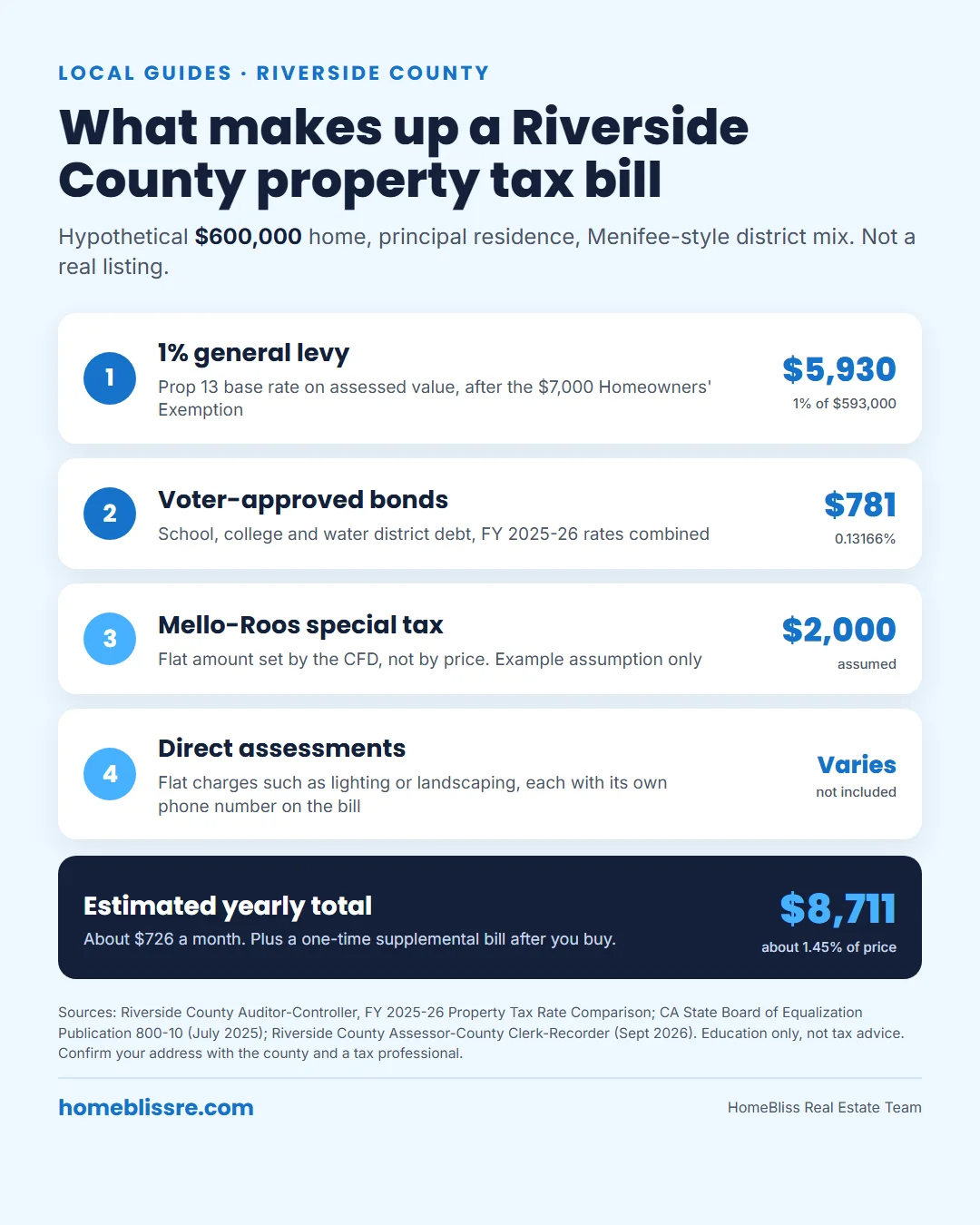
Every Riverside County property tax bill is built from four pieces. The first is the 1% general levy. The second is voter-approved bond debt, charged as a small extra percentage. The third is any Mello-Roos special tax from a Community Facilities District. The fourth is direct assessments, which are flat charges for things like lighting or landscaping districts. The first two are ad valorem, meaning they are a percentage of your assessed value. The last two are not, so they do not change when the price changes.
Your assessed value is the key. Under Proposition 13, when you buy a home the purchase price usually becomes the new base year value, and from there that base year value can be adjusted up by no more than 2% a year, according to the California State Board of Equalization. There is one exception. If values drop and the county temporarily lowers your assessment, it can climb back by more than 2% in a single year until it catches up to the 2%-a-year track, as BOE Publication 800-10 shows. That means the seller's current tax bill tells you very little. If they bought ten years ago, their assessed value is probably far below what you are paying, and your bill will be higher than theirs.
If the home will be your principal residence, the Homeowners' Exemption takes $7,000 off the assessed value. You file for it with the Riverside County Assessor after you close.
What are voter-approved bonds, and how much do they add to the 1%?
Voter-approved bonds are debts that local voters signed off on, mostly for school construction, community colleges and water infrastructure. Each district that issued bonds sets a rate every year, and the Riverside County Auditor-Controller adds those rates to the 1% based on your parcel's tax rate area. Here are the fiscal year 2025-26 rates for the districts that cover much of Menifee, Temecula and Murrieta.
| District (bond debt) | FY 2024-25 rate | FY 2025-26 rate |
|---|---|---|
| General levy (every parcel) | 1.00000% | 1.00000% |
| Menifee Union School District | 0.05080% | 0.07500% |
| Perris Union High School District | 0.06850% | 0.04712% |
| Temecula Valley Unified School District | 0.01924% | 0.01498% |
| Murrieta Valley Unified School District | 0.08645% | 0.08645% |
| Mt. San Jacinto Community College District | 0.00268% | 0.00254% |
| Metropolitan Water District (East) | 0.00700% | 0.00700% |
Source: Riverside County Auditor-Controller, FY 2025-26 Property Tax Rate Comparison. Rates are a percentage of assessed value.
So what does that add up to? A parcel that sits inside Menifee Union, Perris Union High, Mt. San Jacinto College and the Metropolitan Water District East area would carry about 1.13166% for 2025-26 before any Mello-Roos. A Temecula parcel inside Temecula Valley Unified, Mt. San Jacinto College and the same water district would carry about 1.02452%.
Notice the Menifee Union rate went from 0.05080% to 0.07500% in one year. Bond rates move every year as districts pay down debt or voters approve new bonds, so a number from last year's listing is a starting point, not a promise.
What is Mello-Roos, and how is it different from a direct assessment?
Mello-Roos is a special tax charged by a Community Facilities District, or CFD. A CFD is formed so a developer or city can sell bonds to pay for the roads, schools, parks and sewer lines a new neighborhood needs, and the homeowners inside it repay that debt over time. The City of Temecula describes it as a special tax on real estate "in addition to the normal property tax."
Here is the part buyers miss. Mello-Roos is not a percentage of your price. Each CFD has a formula, called a Rate and Method of Apportionment, that usually sets the tax by things like home size or lot type. Two homes on the same street can have different prices and the same Mello-Roos, and a cheaper resale home can carry more Mello-Roos than a pricier home one tract over.
- Menifee: the city runs its own CFDs, including citywide maintenance CFD 2015-2, which pays for street lighting, landscape maintenance and street sweeping in newer developments. The city says these special taxes are billed through the County of Riverside as separate line items on the property tax bill.
- Temecula: the Temecula Public Financing Authority lists 10 CFDs, including Harveston, Wolf Creek, Crowne Hill, Roripaugh Ranch, Heirloom Farms, Altair and Prado. School districts and other agencies can form their own CFDs too, so a single parcel can sit in more than one.
Direct assessments are the other flat charges. They pay for specific services such as lighting, landscaping or flood control. The Board of Equalization notes that each special assessment or direct levy on your county bill has a phone number printed next to it, which is the fastest way to find out what a charge is for.
What would the tax bill be on a hypothetical $600,000 home?
Let's run the numbers on a hypothetical $600,000 home used as a principal residence. This is not a real listing. The bond rates are the FY 2025-26 district combinations from the table above. The $2,000 Mello-Roos figure is an assumption for the example, not an average for Menifee or Temecula, because real CFD amounts vary by tract.
| Line on the bill | How it is figured | Menifee-style district mix | Temecula-style district mix |
|---|---|---|---|
| Assessed value | Purchase price | $600,000 | $600,000 |
| Homeowners' Exemption | Minus $7,000 | $593,000 taxable | $593,000 taxable |
| 1% general levy | 1% of $593,000 | $5,930 | $5,930 |
| Voter-approved bonds | 0.13166% or 0.02452% of $593,000 | $781 | $145 |
| Mello-Roos special tax | Flat, set by the CFD (assumed) | $2,000 | $2,000 |
| Direct assessments | Flat, varies by parcel | Not included | Not included |
| Estimated yearly total | $8,711 | $8,075 | |
| Per month (divided by 12) | About $726 | About $673 |
Look at what the Mello-Roos line does. On this example it adds a third of a point to the effective rate, taking the Menifee-style bill from about 1.12% of the price to about 1.45%. That is why a lender's quick estimate at a flat 1.25% can be off in either direction on a newer home. Swap in the real Mello-Roos and assessment amounts for the address you are looking at, and confirm the result with the county and a tax professional.
What is the supplemental tax bill you get after you buy?
A supplemental tax bill is a one-time catch-up bill that shows up after you buy. When a home changes ownership or new construction is completed, the Riverside County Assessor reappraises it, and the supplemental bill charges tax on the difference between the old assessed value and the new one for the rest of the fiscal year, which ends June 30. If you close between January 1 and May 31, the Assessor says you will get two supplemental bills, one for the current fiscal year and one for the next.
Here is a hypothetical. The seller's assessed value was $350,000 and you buy at $600,000. The $250,000 difference, at a 1.13166% rate, works out to about $2,829 for a full year, and the county bills only the share for the months left in the fiscal year. Close in the fall and you could see a bill for a good part of that.
The big catch: the Assessor says the supplemental bill goes directly to you, not to your mortgage company, even if your lender pays your regular bill from an impound account. Set that money aside. The Assessor's online Supplemental Tax Estimator can give you a rough number on a resale home, but the county notes it is built for changes in ownership only, not new construction.
How do you look up property taxes and Mello-Roos for an address before you offer?
You can do this homework yourself before you write an offer. This is the order we walk our buyers through.
- Get the parcel number (APN). It is on the listing detail, the preliminary title report, or the seller's tax bill.
- Pull the current bill from the Treasurer-Tax Collector. The bill lists every bond rate, special tax and assessment on the parcel line by line. Ignore the seller's total, since it is based on their assessed value. Copy down the flat charges and the combined ad valorem rate.
- Find the tax rate area. The Board of Equalization's Riverside County tax rate area maps show which combination of districts covers a parcel. The Auditor-Controller posts the current rates.
- Check the city's CFD list. Start with the City of Menifee CFD page or the City of Temecula Debt Management page, then ask the local school district about its CFDs.
- Read the Notice of Special Tax. Under California Civil Code section 1102.6b, a seller of a home subject to a Mello-Roos lien must make a good faith effort to get and deliver a disclosure notice. It shows the CFD name, this year's tax, the maximum tax that can ever be charged, how much that maximum can rise each year, and the date the tax ends.
- Estimate the supplemental bill with the Assessor's estimator on a resale, and budget for it in cash.
Brutally honest, the maximum tax and the end date are the two lines people skip, and they are the two that matter most if you plan to stay a while.