
Can you sell an inherited house before probate is finished?
Yes, and a lot of families do. If you lost a parent and the house is sitting in Temecula, Murrieta or Menifee, the first thing to know is that you do not have to wait for the whole case to close before the house can be sold. What you do need is the right person holding the right paperwork.
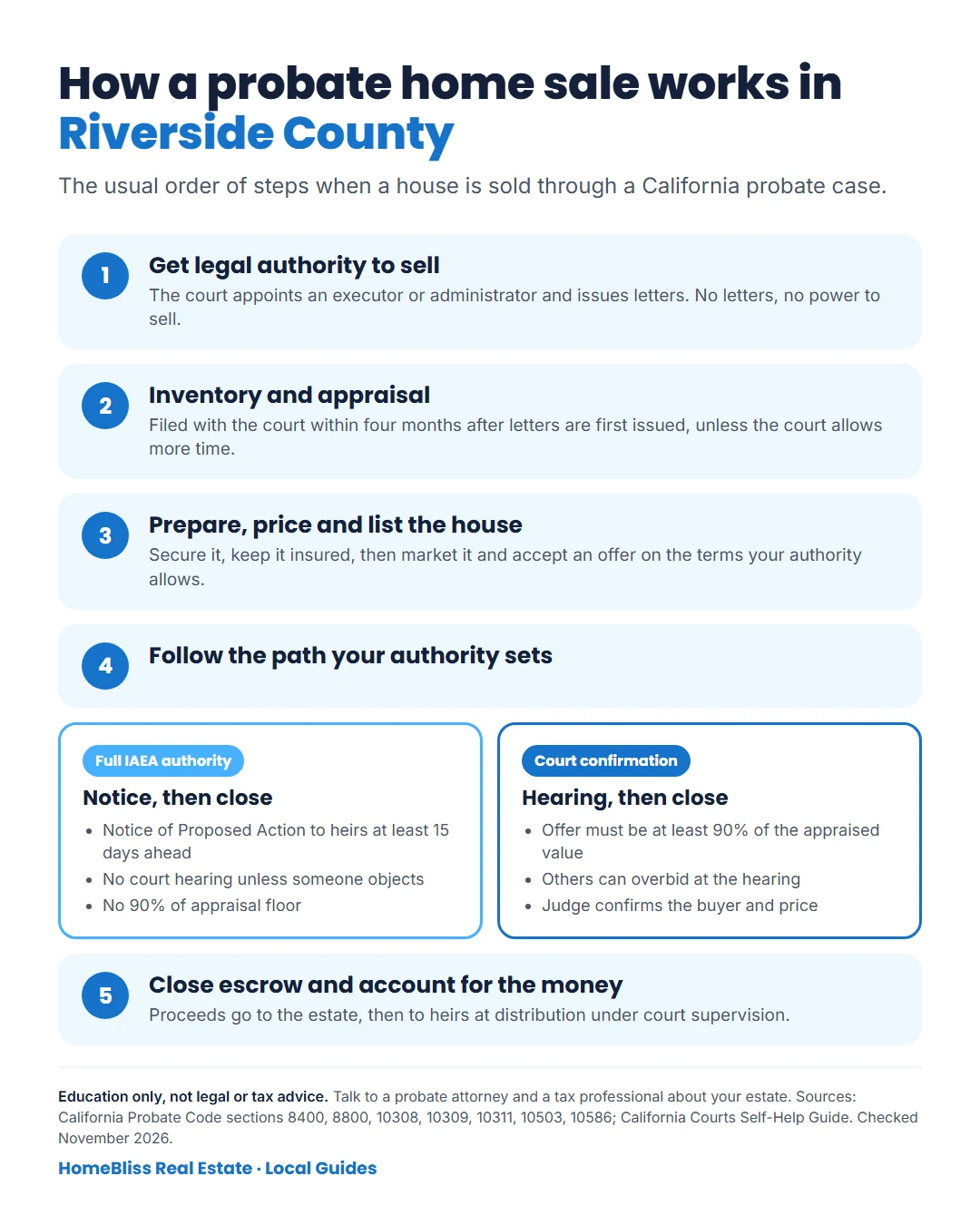
Now, here is the part that trips people up. Being named executor in the will, or being the oldest kid, does not give you the power to sell by itself. California Probate Code section 8400 says a person has no power to administer the estate until the court appoints them and issues letters. Those letters are the document escrow and title will ask for. If the home was in a living trust, it works differently: the successor trustee named in the trust signs, and there is usually no probate case at all.
So before anyone talks about price, the first question is who has authority to sell, and what kind. That answer decides whether a judge has to approve the sale, how long it takes, and whether another buyer can show up in court and outbid yours.
Does the house have to go through probate at all?
Not always. The California Courts Self-Help Guide lists several ways property can pass without a full probate case, and a house is often one of them.
- Living trust. If the house was deeded into a trust, the successor trustee manages and sells it under the trust's terms. California Probate Code section 16226 gives a trustee the power to sell property at public or private sale.
- Joint tenancy. If the house was owned in joint tenancy, it passes to the surviving owner.
- Transfer on death deed. The Self-Help Guide notes a TOD deed can name beneficiaries for real property.
- Spouse or domestic partner. A Spousal or Domestic Partner Property Petition can confirm that property belongs to the surviving spouse without a full probate.
- Smaller estates. For deaths on or after April 1, 2025, the Self-Help Guide sets a $208,850 limit for the small estate affidavit (which transfers personal property, not a house), a $69,625 limit for the real property of small value affidavit, and a court petition for a main home in California valued up to $750,000. Earlier death dates have lower limits, so the date of death matters.
Brutally honest, the $750,000 main home petition is the one to ask your attorney about. With the median sale price in Temecula around $735,000 for the three months ending August 2026 (Redfin, all home types), a lot of homes here sit right around that line. Whether a home qualifies depends on its value and the rules for that procedure, so get a professional opinion before you count on it.
What is the difference between full and limited authority under the IAEA?
When the court opens a probate case, the personal representative (executor or administrator) can ask for authority under the Independent Administration of Estates Act, the IAEA. There are two levels, and for a house the difference is huge.
Full authority includes the power to sell real property without going back to court for confirmation (section 10511 and section 10503). Before the sale, the representative sends a Notice of Proposed Action to affected heirs and devisees at least 15 days before the action date (section 10581 and section 10586). If someone delivers a written objection, the representative has to use the court-supervised process instead (section 10589).
Limited authority covers most of the same powers, but not selling real property (section 10403). With limited authority, or with no IAEA authority, the house sale goes to court for confirmation.
| How the house is held | Who signs | Court confirmation hearing? | 90% of appraisal floor? | Overbids in court? |
|---|---|---|---|---|
| Living trust | Successor trustee | No, it is not a probate sale | No | No |
| Probate with full IAEA authority | Executor or administrator with letters | No, unless an heir objects to the Notice of Proposed Action | No (section 10503) | No |
| Probate with limited authority or no IAEA authority | Executor or administrator with letters | Yes (section 10308) | Yes (section 10309) | Yes (section 10311) |
Your attorney will know which one you have. It is printed on the letters, and it is the first thing we ask for before we talk about pricing or timing.
How do court confirmation and overbids work?
If the sale needs court confirmation, you still market the house and accept an offer. The difference is that the deal is not final until a judge approves it at a hearing, and Probate Code section 10308 says title does not pass to the buyer until then.
Three rules shape that hearing:
- The 90% rule. The house must have been appraised within one year before the hearing, and the offer has to be at least 90% of that appraised value (section 10309). On a home appraised at $650,000, an offer under $585,000 cannot be confirmed.
- The court looks at the effort. The judge examines whether the representative tried to get the highest and best price reasonably attainable, and any interested person can file written objections (section 10310).
- Overbids. Another buyer can come to the hearing with a written offer. To count, it has to be at least 10% more on the first $10,000 of the original bid and 5% more on everything above $10,000 (section 10311).
Here is that overbid math on a hypothetical accepted offer of $600,000: 10% of the first $10,000 is $1,000, and 5% of the remaining $590,000 is $29,500. So the first overbid has to be at least $630,500. If someone beats it, the court can confirm the sale to them instead of your original buyer.
In Riverside County, probate examiners review the petition before the hearing and post probate notes that you can look up by case number on the Riverside Superior Court probate page. The court is clear that its examiners cannot give legal advice, which is one more reason to have an attorney on this part.
What does this mean for a buyer? They should expect the wait and the chance of being outbid. Some buyers walk away from that, and that is something to weigh when you compare offers.
Should heirs keep the house or sell it, and how does Prop 19 change that?
This is where a lot of families get surprised. Before Prop 19, kids could often inherit a parent's low property tax base on almost any home. For transfers on or after February 16, 2021, that changed. According to the State Board of Equalization, here is how it breaks down:
| What the heirs do | Property tax result under Prop 19 |
|---|---|
| A child moves in and makes it their principal residence, files the homeowners' exemption within one year | The parent's factored base year value can carry over, plus up to $1,044,586 of extra value for transfers from Feb 16, 2025 to Feb 15, 2027. Anything above that is added to the taxable value. |
| The heirs keep it as a rental or second home | No exclusion. Prop 19 removed it for property other than a principal residence or family farm, so the home is reassessed. |
| The child moves in, then later moves out | Reassessed as of the next lien date after they stop living there. |
| The heirs sell the house | The buyer's purchase is a new change in ownership, so it is reassessed for the buyer like any other sale. |
The BOE also says the exclusion claim has to be filed within three years of the death or transfer, or before a transfer to a third party, whichever is earlier. So if one sibling plans to move in, do not let that deadline slide while you sort out everything else.
Keep or sell is a family decision, and I am not going to tell you which one is right. What I can tell you is that a rental you inherit will usually carry a much higher tax bill than your parents paid. Our Riverside County property tax guide walks through how that bill is built, Mello-Roos included.
What taxes and costs come up when you sell an inherited house?
We are not tax advisors, so treat this as background to bring to your CPA or tax professional.
Step-up in basis. For federal taxes, IRS Publication 551 says the basis of inherited property is generally its fair market value on the date of death, or on the alternate valuation date if the estate's representative elects it. Put simply, the gain is usually measured from the value when your parent passed, not from what they paid decades ago. That is why a date-of-death appraisal matters, and why capital gains on inherited property are often smaller than families expect.
The usual selling costs still apply. Escrow, title, prorated property taxes, any repairs or credits, and agent compensation all come out of the proceeds. Riverside County's documentary transfer tax is $1.10 per $1,000 of value, and the City of Riverside is the only city in the county that adds its own. Our seller net sheet guide runs every line.
Probate costs. Attorney and personal representative compensation and court costs are part of the estate's expenses, and under Probate Code section 10501 those fees still need court approval even with full IAEA authority. Ask your attorney for an estimate early, because they affect what each heir actually receives.
What should you do with the house while you wait?
Probate takes months. In the meantime, the house still needs someone looking after it. California Probate Code section 8400 lets a person named as executor take necessary steps to maintain and preserve the estate even before letters issue. Here is the short list we walk families through:
- Secure it. Change or rekey the locks, and keep a list of who has a key.
- Call the insurance company. Tell them the owner passed and whether the home is vacant. Vacant homes are often treated differently, so ask what the policy requires.
- Keep paying the essentials. Mortgage, property taxes, HOA dues and basic utilities keep coming. Missed payments hurt the estate.
- Do not give it away yet. Hold off on clearing out valuables or moving anyone in until the attorney says who has authority.
- Get a value. A date-of-death value helps the attorney with the inventory, which Probate Code section 8800 says is due within four months after letters are first issued, and helps your tax professional with the basis.
And if the house needs work, that is okay. Inherited homes rarely show like a model. Whether you fix things, sell as is, or compare a cash offer, the Sold Simple page puts the options side by side so the family can see the numbers before anyone decides.