
What is a seller net sheet, and what goes on one?
A seller net sheet is a written estimate of the check you walk away with. If you are thinking about selling in Temecula, Murrieta or Menifee, it is the one number that actually matters, and it is the same math behind our Sold Simple cash offer vs listing comparison. Price is what the buyer pays. Net is what you keep.
Every net sheet follows the same order. It starts with the sale price. Then it subtracts the costs of the sale itself: brokerage compensation, escrow, title, transfer tax, prorated property taxes, HOA fees, and anything you agreed to give the buyer in repairs or credits. Then it subtracts what you owe: your mortgage payoff and any other lien on the house. The number at the bottom is your estimated net proceeds.
Now, a net sheet is an estimate, not a promise. The final number comes from escrow's settlement statement at closing, after the payoff is ordered and the prorations are run to the actual closing date.
Who pays which closing costs when you sell in Riverside County?
California does not have one law that splits every closing cost. A few items are set by law, like the transfer tax rate and the required disclosures. The rest follows local custom, and custom in Riverside County is different from Northern California. Here is how the closing costs for a seller in California usually fall here, based on the Old Republic Title guide to California closing costs and the state and county sources listed below the table.
| Seller cost | Who customarily pays in Riverside County | Where the rule or custom comes from |
|---|---|---|
| Listing brokerage compensation | Seller, at a rate you negotiate | Your listing agreement; NAR says compensation is negotiable and not set by law |
| Buyer's agent compensation | Negotiated. The buyer's agreement sets it, and the seller may agree to pay some or all of it | NAR practice changes effective August 17, 2024 |
| Escrow fee | Split 50/50 between buyer and seller | Old Republic Title, Guide to California Closing Costs |
| Owner's title insurance policy | Seller | Old Republic Title, Guide to California Closing Costs |
| County documentary transfer tax | Seller | Riverside County Recorder rate; Old Republic Title for custom |
| Property taxes | Prorated. You pay your share up to the closing date | Your purchase contract and escrow instructions |
| HOA transfer and document fees | Set by the purchase contract. The seller must deliver the HOA documents either way | Civil Code 4525 and 4530 (the seller provides the documents; the HOA may charge for them) |
| Loan payoff and reconveyance | Seller, out of proceeds | Your lender's payoff statement |
| Natural hazard disclosure report | Seller, since the disclosure is the seller's duty; the contract can say otherwise | Civil Code 1103.2 requires the disclosure |
| Repairs, credits and home warranty | Whatever you negotiate | Your purchase contract |
Anything in the contract beats local custom. If the buyer's offer asks you to pay a cost that custom puts on them, that is a term you can accept, counter or refuse.
How much is the transfer tax in Riverside County, and do Temecula, Murrieta or Menifee add one?
The Riverside County documentary transfer tax is $0.55 for every $500 of value, according to the Riverside County Assessor-County Clerk-Recorder. That works out to $1.10 per $1,000. On a $735,000 sale it is about $809, and in Riverside County the seller customarily pays it. The rate is figured on the value transferred, excluding any existing loan the buyer takes over, which almost never happens in a normal sale.
Some California cities stack their own transfer tax on top of the county's. In Riverside County, the recorder's page lists one city with an added rate: the City of Riverside. Temecula, Murrieta and Menifee are not on it, so a sale in those three cities pays the county rate only. If you are selling in another city, check that page or ask escrow before you count on the county number.
What would a seller net sheet look like on a $735,000 Temecula home?
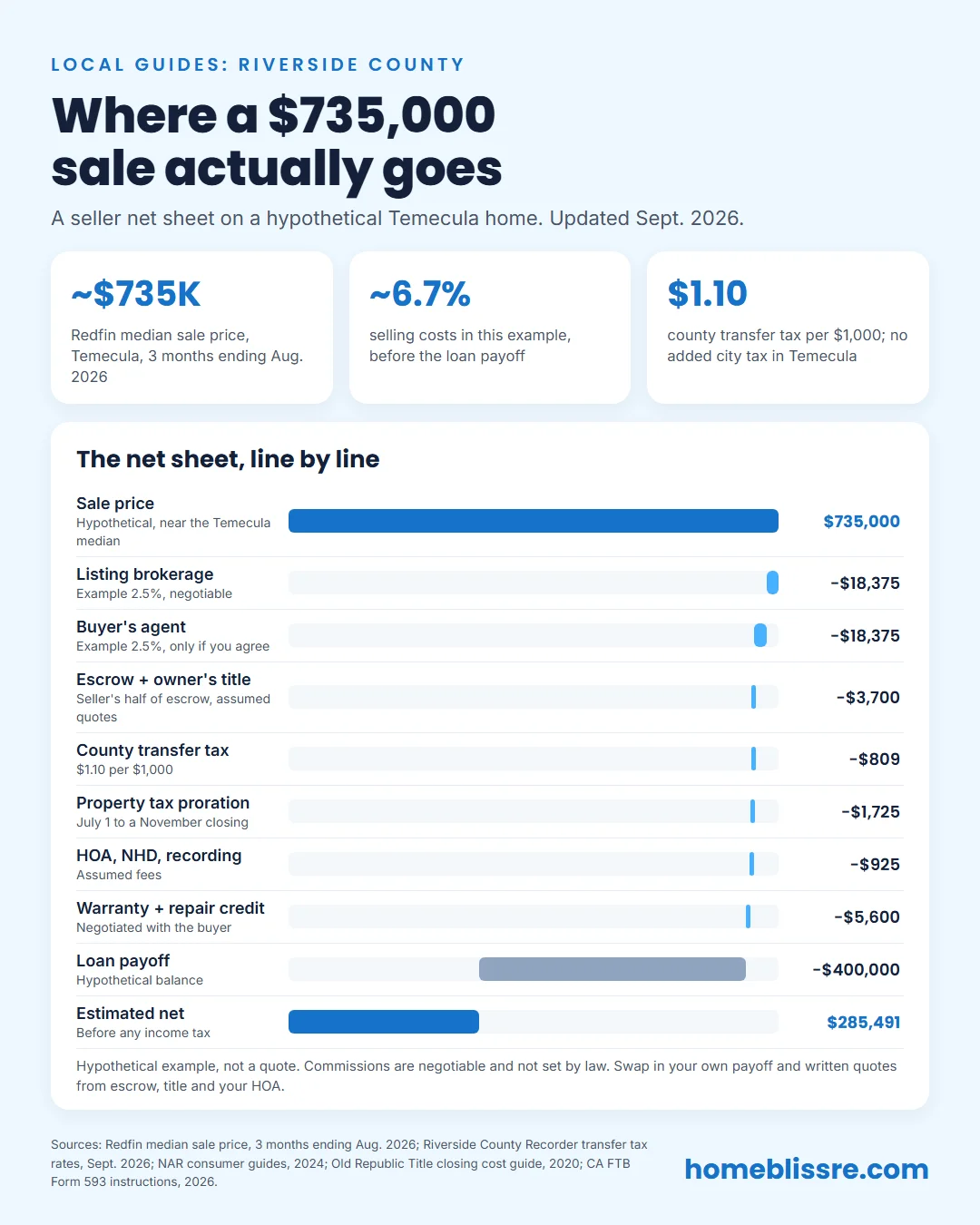
Let's run one. This is a hypothetical home, not a real listing and not a quote. The $735,000 price is close to Redfin's Temecula median sale price for the three months ending August 2026. The $400,000 loan payoff is made up for the example. Every line marked "assumed" is a placeholder you swap for a real quote from your escrow officer, title company or HOA.
| Line on the net sheet | Amount | How it is figured |
|---|---|---|
| Sale price (hypothetical) | $735,000 | Near the Temecula median above |
| Listing brokerage compensation | -$18,375 | Example 2.5% of price. Negotiable, not set by law |
| Buyer's agent compensation, only if you agree to pay it | -$18,375 | Example 2.5% of price. Negotiated separately since August 2024 |
| Escrow fee, seller's half | -$1,500 | Assumed. Ask escrow for a written quote |
| Owner's title insurance policy | -$2,200 | Assumed. Ask title for a written quote |
| Riverside County documentary transfer tax | -$809 | $1.10 per $1,000 of $735,000 ($808.50) |
| Property tax proration, July 1 to closing | -$1,725 | Assumed seller bill of $4,600 a year, mid-November closing |
| HOA transfer and document fees | -$500 | Assumed. Set by the association |
| Natural hazard disclosure report | -$125 | Assumed. Varies by provider |
| Reconveyance, recording, notary and wire fees | -$300 | Assumed |
| Home warranty for the buyer (optional) | -$600 | Assumed. Only if you offer one |
| Repair credit to the buyer | -$5,000 | Assumed. Negotiated after inspections |
| Total selling costs | -$49,509 | About 6.7% of the price |
| Mortgage payoff | -$400,000 | Hypothetical balance plus interest to the payoff date |
| California withholding | $0 | Exempt as a principal residence (Form 593) |
| Estimated net to you | $285,491 | Before any income tax you may owe |
Look at where the money goes. The two brokerage lines are the biggest, which is why they are worth a real conversation. Commissions are negotiable and not set by law, and since August 17, 2024 the buyer's agent's pay is negotiated in a written agreement with the buyer, according to the National Association of REALTORS. A seller can still agree to cover some or all of it. The rates in this table are examples, not a standard.
The fixed costs are small next to that. Escrow, title, the transfer tax and the small fees add up to about $5,400 here. The property tax line depends on timing. Riverside County's tax year runs July 1 to June 30, so if you close in November you owe roughly four and a half months of the year, and escrow settles it with the buyer.
Cash offer vs listing: how do the two net sheets compare?
Here is the same hypothetical home, sold two ways. A cash buyer or iBuyer is paying for speed and certainty, and their offer is usually below market value. We could not find a reliable published figure for how far below, because it changes by house, condition and buyer. So the $660,000 cash offer below is an adjustable example, about 10% under the listed price. Slide it up or down to match a real offer.
| Same hypothetical home | Listed on the market | Cash offer (example) |
|---|---|---|
| Price or offer | $735,000 | $660,000 |
| Brokerage compensation (both sides) | -$36,750 | $0 in this example |
| Escrow fee, seller's half | -$1,500 | -$1,500 |
| Owner's title insurance policy | -$2,200 | -$2,000 |
| County transfer tax | -$809 | -$726 |
| Property tax proration | -$1,725 | -$1,725 |
| HOA transfer and document fees | -$500 | -$500 |
| NHD report, recording and wire fees | -$425 | -$425 |
| Home warranty and repair credit | -$5,600 | $0 |
| Prep and cleaning before listing | -$2,500 | $0 |
| Holding costs while listed | -$7,000 | $0 |
| Mortgage payoff | -$400,000 | -$400,000 |
| Estimated net | $275,991 | $253,124 |
| Typical timeline | 30 to 60+ days after an accepted offer | Often a few weeks, on a date you choose |
In this example the listing nets about $22,867 more. That gap is not a rule. Every $10,000 you move the cash offer moves the gap by roughly $10,000, and a house that needs a roof or a full remodel changes the listing column fast, because the repair credit and prep lines get much bigger. The cash column also assumes the offer is already net of any program service fee. Some cash programs deduct a fee or repair costs from the offer, so read the written terms line by line.
The holding cost line is the one people forget. While a home is on the market you keep paying the mortgage, taxes, insurance and utilities. We assumed $7,000 for about two extra months.
This is exactly why the Sold Simple page puts a real cash offer next to an estimated open-market net for your home, in writing. HomeBliss does not buy houses. The cash offer comes from a third-party buyer, and the comparison is there so you can see the trade before you pick one.
Does selling a house as is in California change your costs or your disclosures?
Selling a house as is in California means you are telling buyers up front that you will not make repairs. It does not mean you can skip disclosures. California Civil Code section 1102.1 says delivery of the Real Estate Transfer Disclosure Statement, the TDS, may not be waived in an "as is" sale. You still disclose the problems you know about.
- TDS: the state form where you describe the condition of the home and the defects you know about.
- SPQ: the California Association of REALTORS Seller Property Questionnaire. C.A.R. describes it as a supplement to the TDS, not a replacement.
- Natural hazard disclosure: required by Civil Code 1103.2 for homes in mapped flood, fire, fault and similar zones. Most sellers order a third-party report for this.
On a net sheet, as is mostly changes two lines. The repair credit can drop to zero, and the price usually comes down, because the buyer is pricing in the work. Buyers can still inspect and can still walk away under their contingencies. Brutally honest, an as-is sale on the open market and an as-is cash sale are two different things, and the side-by-side table above is how you tell which one nets more for your house.
Will you owe capital gains tax or California withholding when you sell?
Two tax items can touch your net, and we are not tax advisors, so treat this as background and confirm your situation with a CPA or tax professional.
Capital gains. If you owned and lived in the home as your main home for at least two of the last five years, you may be able to exclude up to $250,000 of gain, or up to $500,000 on most joint returns, according to IRS Publication 523. Selling costs generally reduce your gain, so keep your final settlement statement.
California withholding. Escrow must withhold 3 1/3% of the sale price and send it to the Franchise Tax Board unless an exemption applies, according to the FTB's 2026 Form 593 instructions. On a $735,000 sale that would be about $24,475 held back. Common exemptions include a sale price of $100,000 or less, a home that was your principal residence, and a sale at a loss or zero gain. You certify the exemption on Form 593 before closing. If money is withheld, the FTB says it is a prepayment you claim as a credit on your California return, not an extra tax. Rentals and second homes are where sellers get surprised by this line.
How do you get a seller net sheet for your own home?
Ask your agent for one before you list, and a new one for every offer, because price, credits and the closing date all move the bottom line. Bring these so the numbers are real:
- Your latest mortgage statement, plus any HELOC or second loan. For the final number, escrow orders a payoff statement from each lender.
- Your property tax bill from the Riverside County Treasurer-Tax Collector, including any Mello-Roos line.
- Your HOA name and dues, so the HOA's transfer and document fees can be quoted.
- Solar or other liens, if you have a leased or financed system. Those have to be paid off or transferred.
- A list of known repairs, so you can decide early whether to fix, credit or sell as is.
- How the home was used, main home, rental or second home, so the withholding and tax questions get flagged for your tax professional.
If you want the cash side too, the Sold Simple request takes about two minutes and gets you both numbers in writing. Selling in Menifee, Murrieta or Temecula specifically? Our Menifee and Murrieta guides cover the local market around the house.